The Billion-Molecule Microscope
Scientists just built a mass spectrometer that analyzes billions of molecules at once—and it could revolutionize medicine.
Dr. Sarah Chen
Author
March 27, 2026
Published
3 min read
Reading time
5 views
Total views
The Billion-Molecule Microscope
Imagine trying to read every book in the Library of Congress—but you can only look at one letter at a time. That's essentially how mass spectrometers have worked for over a century. These incredible machines identify molecules by weighing them, but they've always been stuck analyzing things one by one.
Until now.
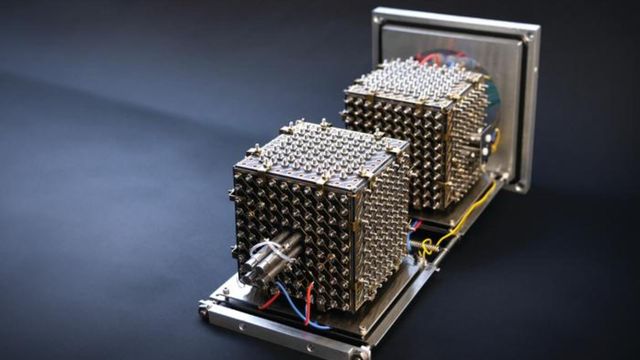
Scientists at Rockefeller University have just built a prototype that shatters this limitation. Called MultiQ-IT, it can analyze billions of molecules simultaneously—a thousand times more than conventional instruments. It's like going from reading letter by letter to scanning entire libraries in a single glance.
The DNA Sequencing Revolution, But for Molecules
"What revolutionized DNA sequencing wasn't any change in the underlying chemistry," says lead researcher Brian T. Chait. "It was the ability to run so many chemical reactions in parallel, which took genome sequencing from a billion-dollar effort to something that costs around $100."
He's talking about the same transformation that gave us GPUs in computing—breaking big problems into thousands of tiny tasks that get solved simultaneously. Now his team has applied this "massive parallelization" to mass spectrometry.
The results are staggering: a 100-fold improvement in signal-to-noise ratio, meaning scientists can detect molecules that were previously invisible.
Nature's Blueprint: The Cell's Secret
The breakthrough came from an unlikely source: how molecules move through a cell's nucleus.
For decades, Chait's team studied nuclear pore complexes—tiny gateways that control traffic in and out of the nucleus. Cells don't use one big door; they use hundreds of small openings working in parallel.
"We wondered whether mass spectrometry could be redesigned along these lines," Chait explains.
Their solution? A cube-shaped chamber with hundreds of electrically controlled openings. Inside, ions (charged molecules) bounce around like balls in a pinball machine, getting sorted, held, and directed through multiple pathways simultaneously.
Finding Needles in Molecular Haystacks
Here's why this matters: in biology, the rarest molecules are often the most important.
Think of a cancer cell. Among millions of ordinary proteins might be a handful of mutant ones driving the disease. Current mass spectrometers might miss them entirely—they're like trying to hear a whisper in a rock concert.
MultiQ-IT changes everything. By applying a small electrical voltage, common background molecules escape while rare, biologically important ones get trapped. The system holds up to ten billion charges at once—a thousand times more than conventional traps.
"The least abundant things can be more important than the more abundant things," says senior researcher Andrew Krutchinsky.
What This Means for Your Health
This isn't just lab curiosity. The implications are breathtaking:
Single-cell medicine: Doctors could analyze every protein in a single cancer cell, identifying exactly what makes it tick and which drugs would work best.
Ultra-early disease detection: Find the first few molecules signaling Alzheimer's or Parkinson's years before symptoms appear.
Personalized drug discovery: Test thousands of potential drug candidates simultaneously instead of one by one.
Environmental monitoring: Detect trace pollutants at concentrations we can't even measure today.
From Prototype to Pocket-Sized
Right now, MultiQ-IT is a proof of concept—a blueprint for what's possible. But remember: the first DNA sequencers filled entire rooms. Today, they're smaller than your smartphone.
"There was a lot of development between the discovery of a reaction for sequencing DNA and modern genomics," Chait reminds us. "Decades between the first transistor and putting a billion transistors on a chip. In both cases, someone first had to show it could be done."
The Future in Parallel
We're witnessing the birth of a new era in molecular analysis. Just as parallel computing gave us AI and parallel DNA sequencing gave us personalized medicine, parallel mass spectrometry could give us something even more profound: the ability to see biology in its full, breathtaking complexity.
The next time you hear about a medical breakthrough, remember: it might have started with scientists learning how to listen to billions of molecular whispers at once.